Current case · HuntMate
A connected, human-controlled workspace for the First-Five job-search journey.
When job-search work spans separate tools and stages, people may spend too much effort recreating context and checking whether AI output is grounded in their real evidence.
01 / Opportunity
Start with the jobs people need to complete, then test whether continuity helps.
A category-level scan organized the opportunity around five connected jobs. It is directional framing, not proof of demand, willingness to pay, or market size.
| Job-search work | Question explored | Testable HuntMate opening |
|---|---|---|
| Find and rank | Can a person see fit, constraints, and next actions together? | Prioritized opportunities with visible context. |
| Clarify and tailor | Does generated material stay tied to approved evidence? | Clarification before drafting, then human approval. |
| Apply and follow up | Can commitments remain attached to the opportunity? | Internal state plus a two-day outreach task. |
| Prepare for interviews | Can preparation reuse evidence without inventing claims? | Role-specific preparation grounded in known material. |
| Evaluate an offer | Can AI reduce cognitive load without taking the decision? | Comparison, questions, and negotiation preparation. |
02 / Human + AI
Higher-consequence actions require more evidence and human review.
AI can prepare
- Rank opportunities and explain the visible factors.
- Surface missing evidence and ask focused questions.
- Draft tailored material for review.
- Compare an offer and prepare questions or negotiation points.
The person controls
- What evidence is true and approved.
- Whether a draft is downloaded, edited, or used.
- Every application, email, and employer contact.
- Negotiation, acceptance, decline, and final decisions.
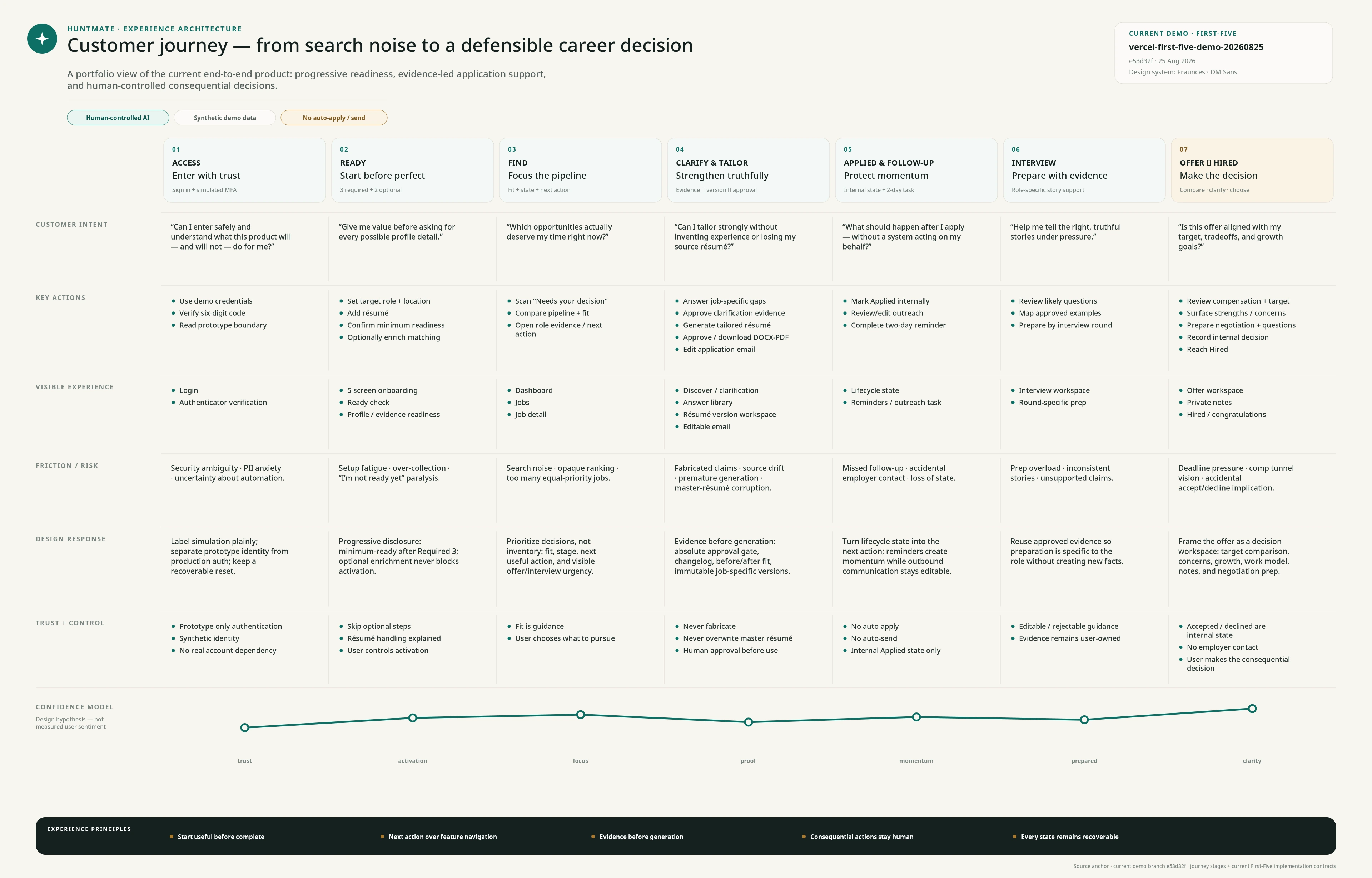
Customer journey V2
Where uncertainty, effort, and consequence change across the journey.
Open full-size artifact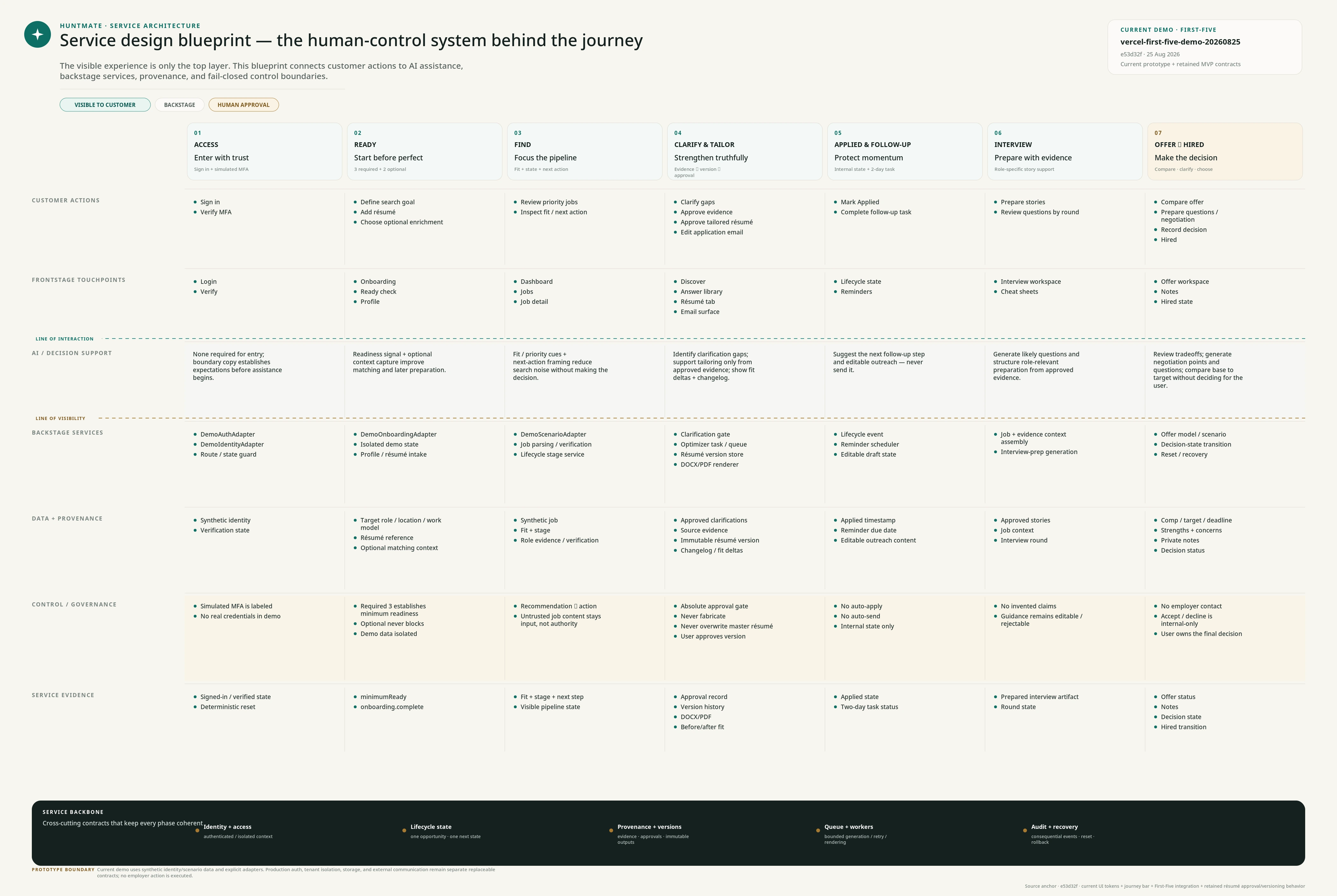
Service design blueprint V2
How product behavior, AI support, safeguards, and evidence work together.
Open full-size artifact03 / Working product proof
The current demo covers the full First-Five journey.
These captures come from the current synthetic demo. They demonstrate working product states, not validated user demand or customer outcomes.
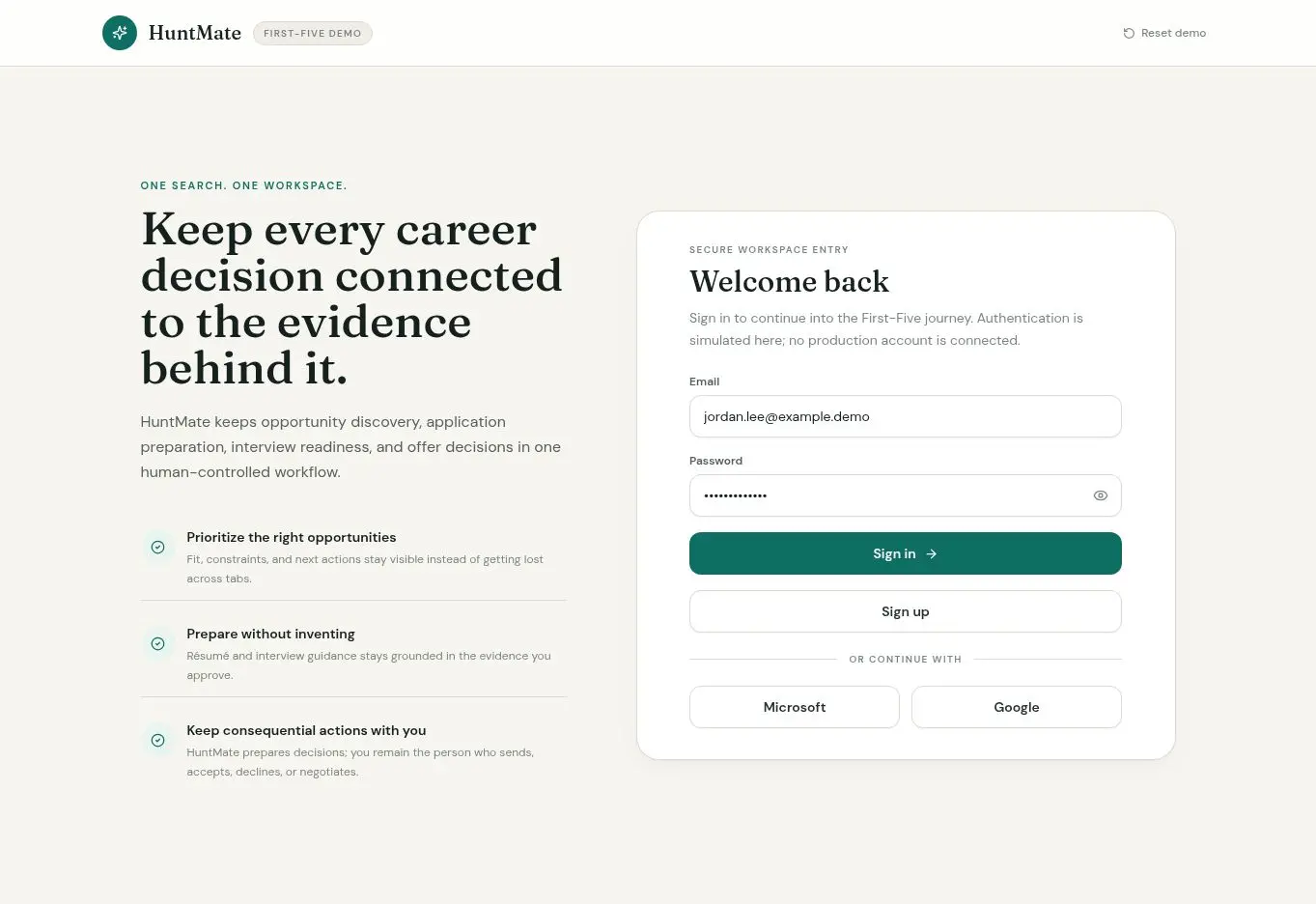
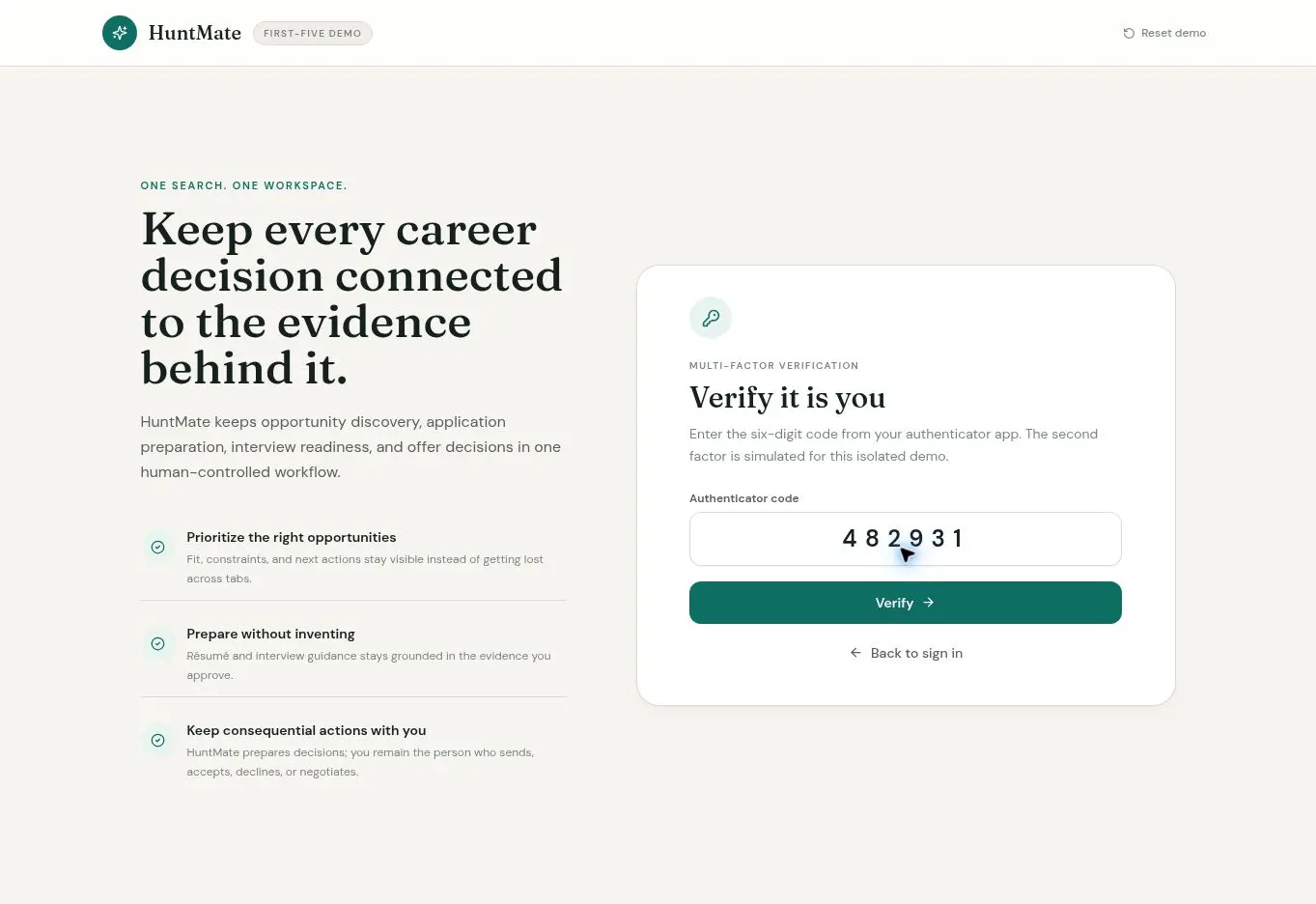
01 · Access and trust
Set the control boundary before AI starts recommending.
Login and simulated MFA make the demo boundary explicit. This is product-flow evidence, not production authentication proof.
02 · Activation and readiness
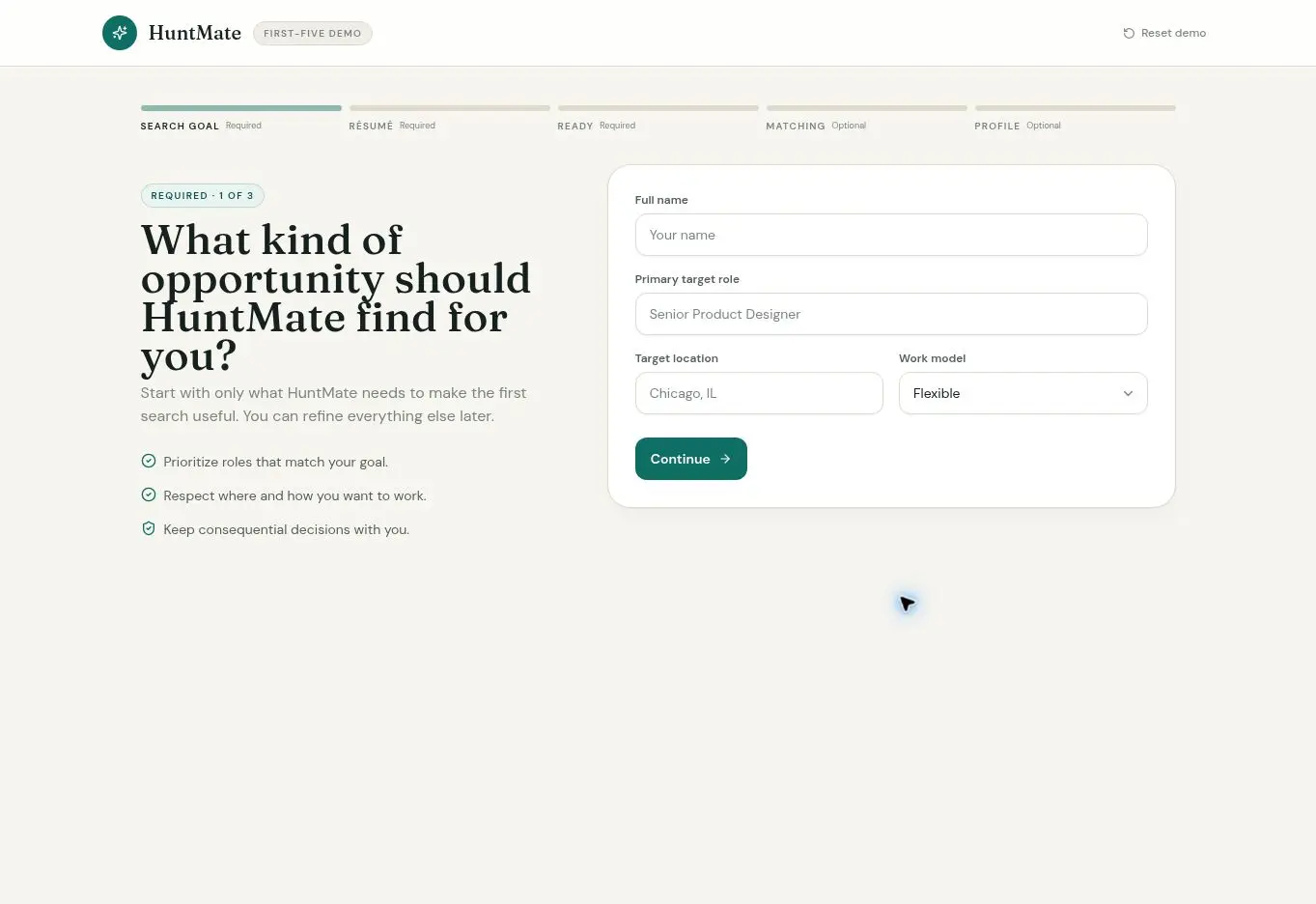
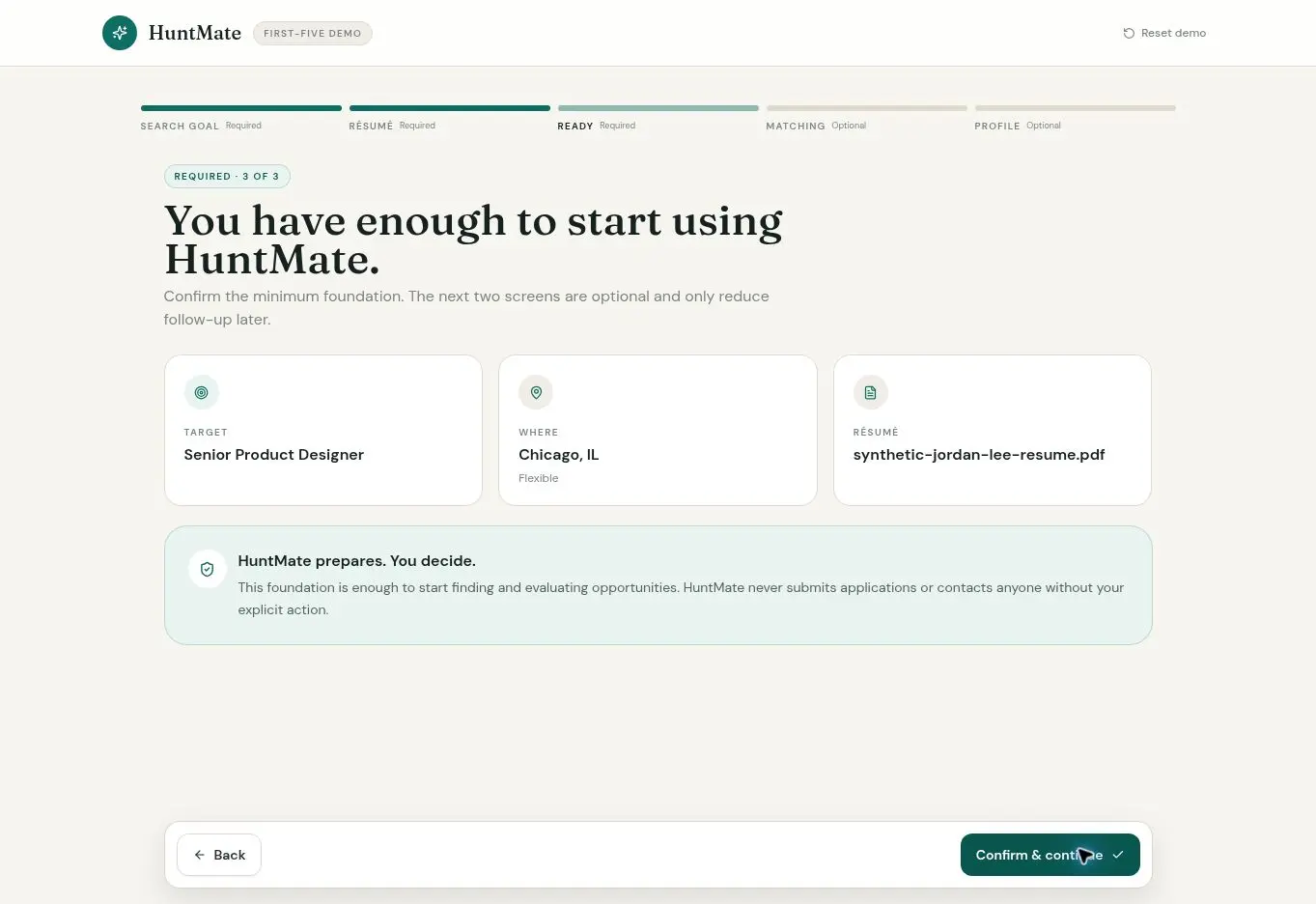
Collect the minimum required context; make deeper enrichment optional.
The flow captures the search goal and résumé metadata, then confirms when the person has enough to start.
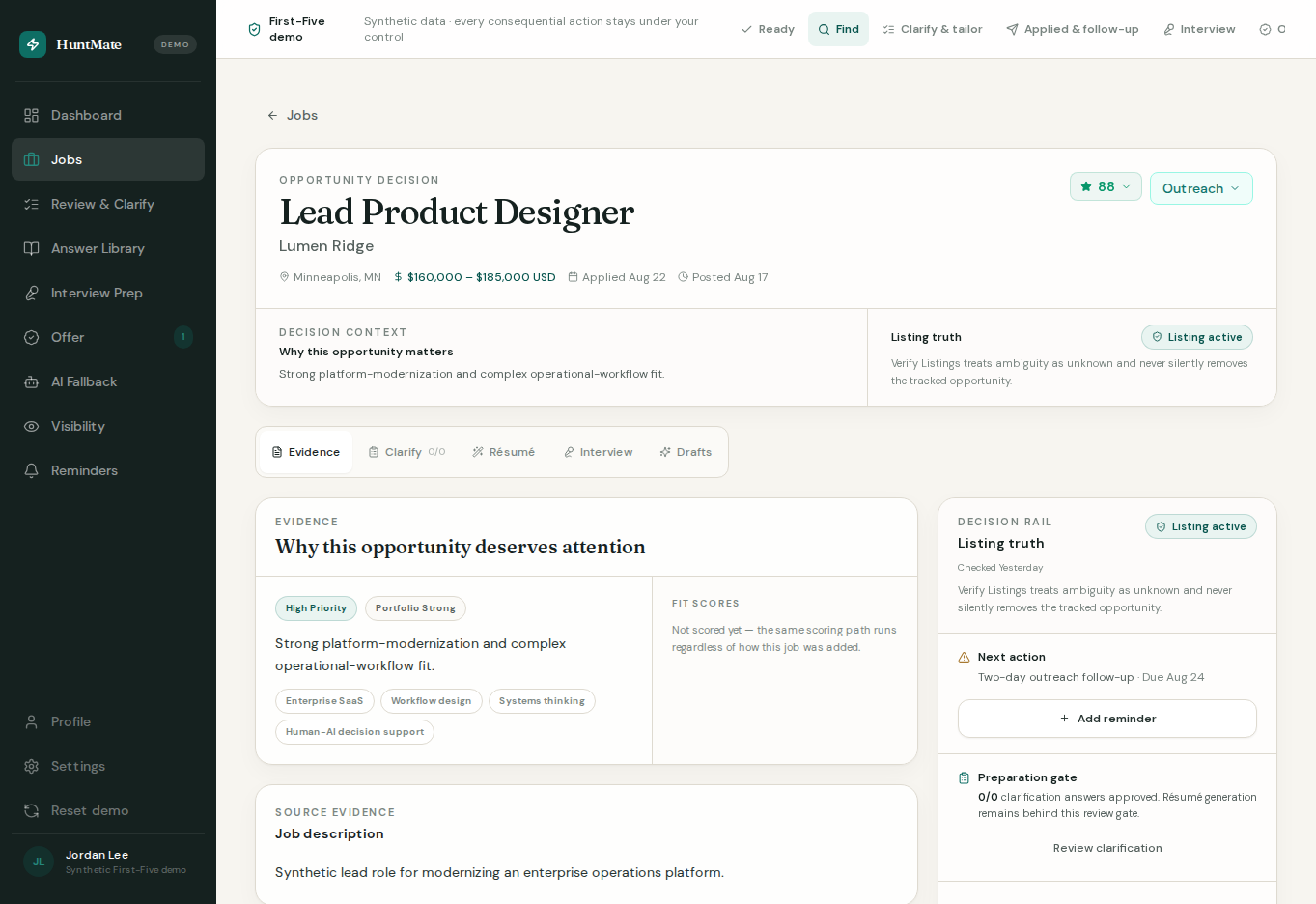
03 · Opportunity and evidence
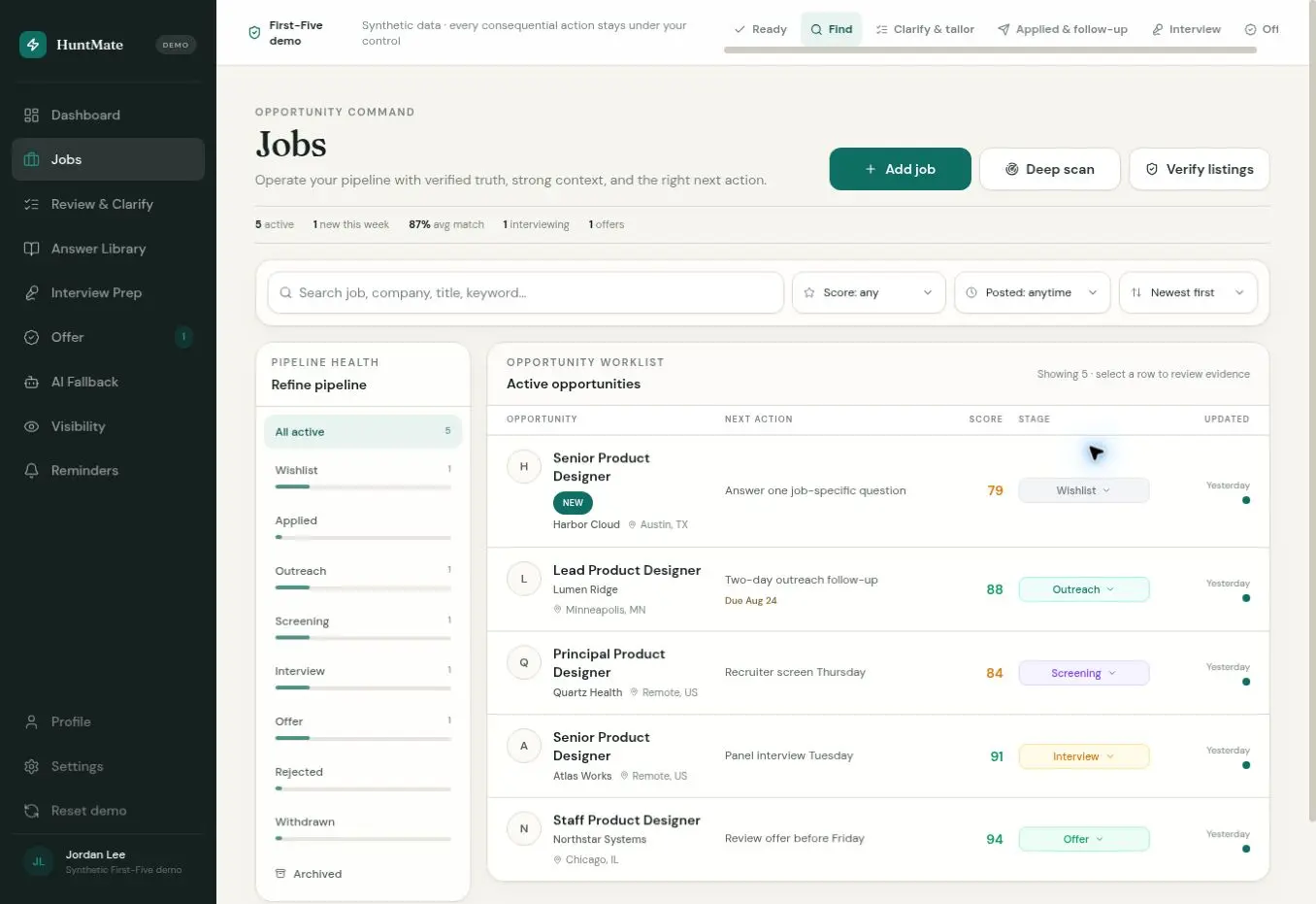
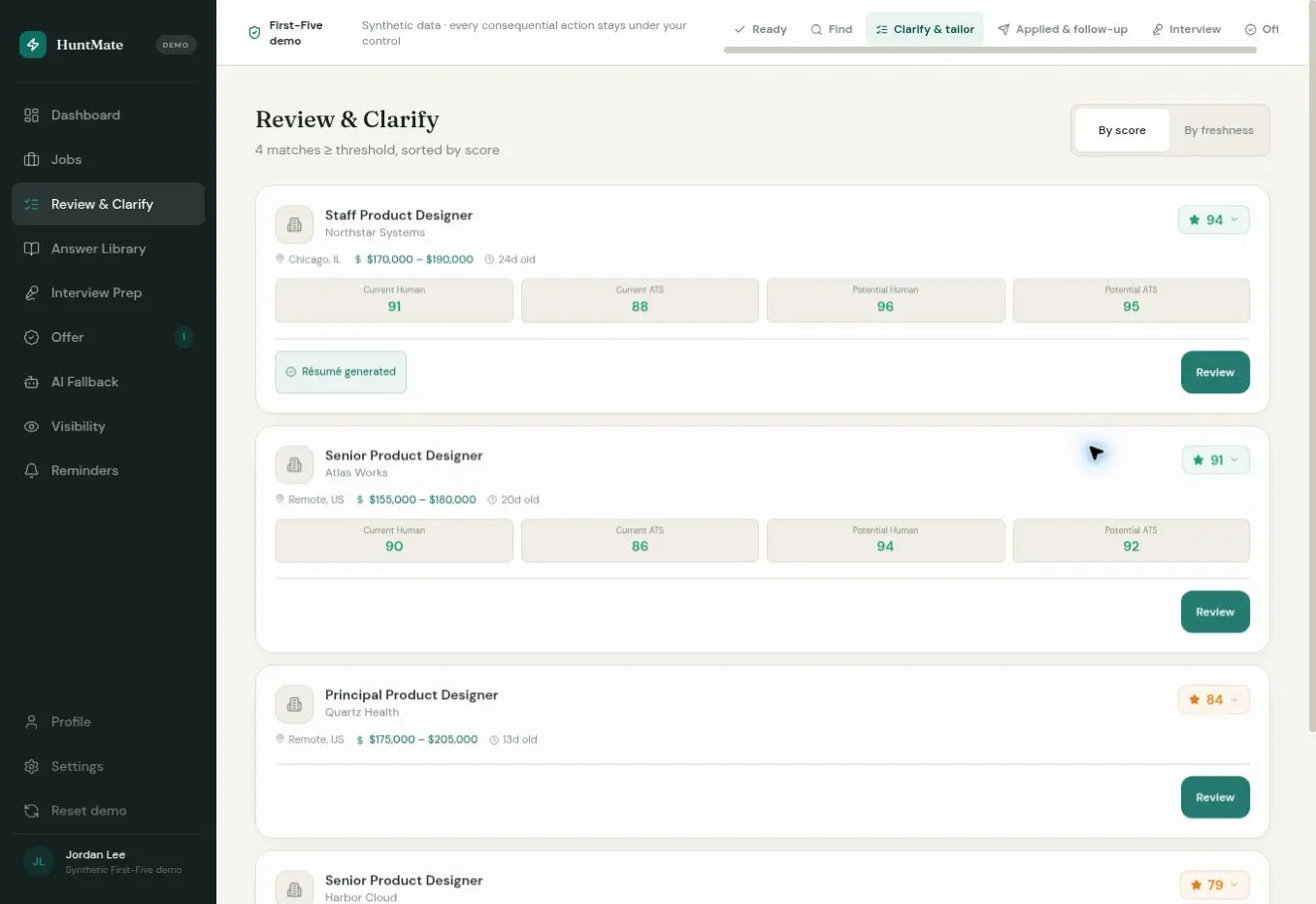
Keep fit, constraints, questions, and approved evidence with the job.
The workspace connects prioritized opportunities to clarification and truthful tailoring. Generated material remains a version to review, not a silent rewrite of the master résumé.
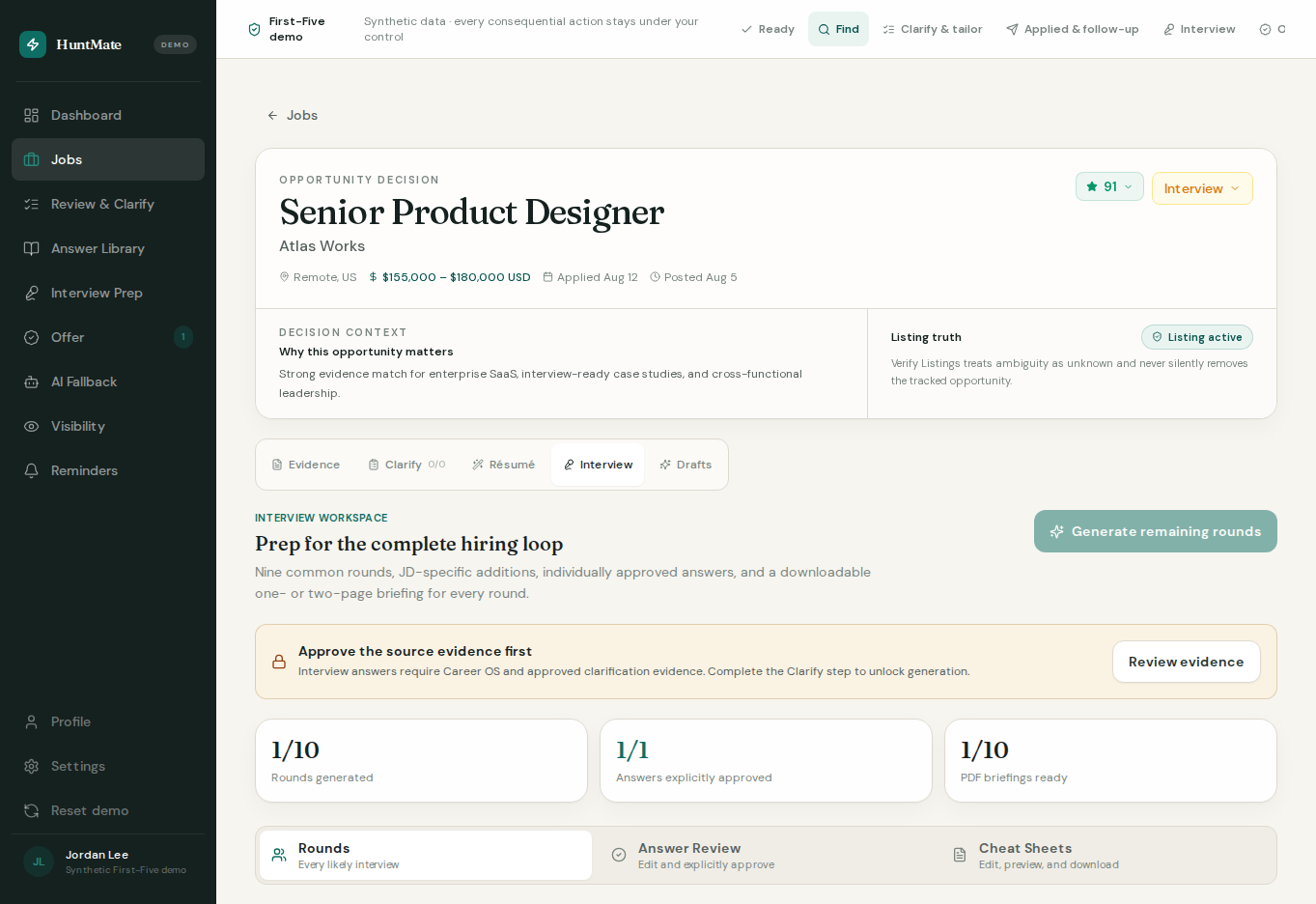
04–05 · Momentum and preparation
Carry the same opportunity context into follow-up and interview work.
Internal Applied state, a two-day outreach task, and role-specific preparation continue the service without sending anything to an employer.
06–07 · Decision and closure
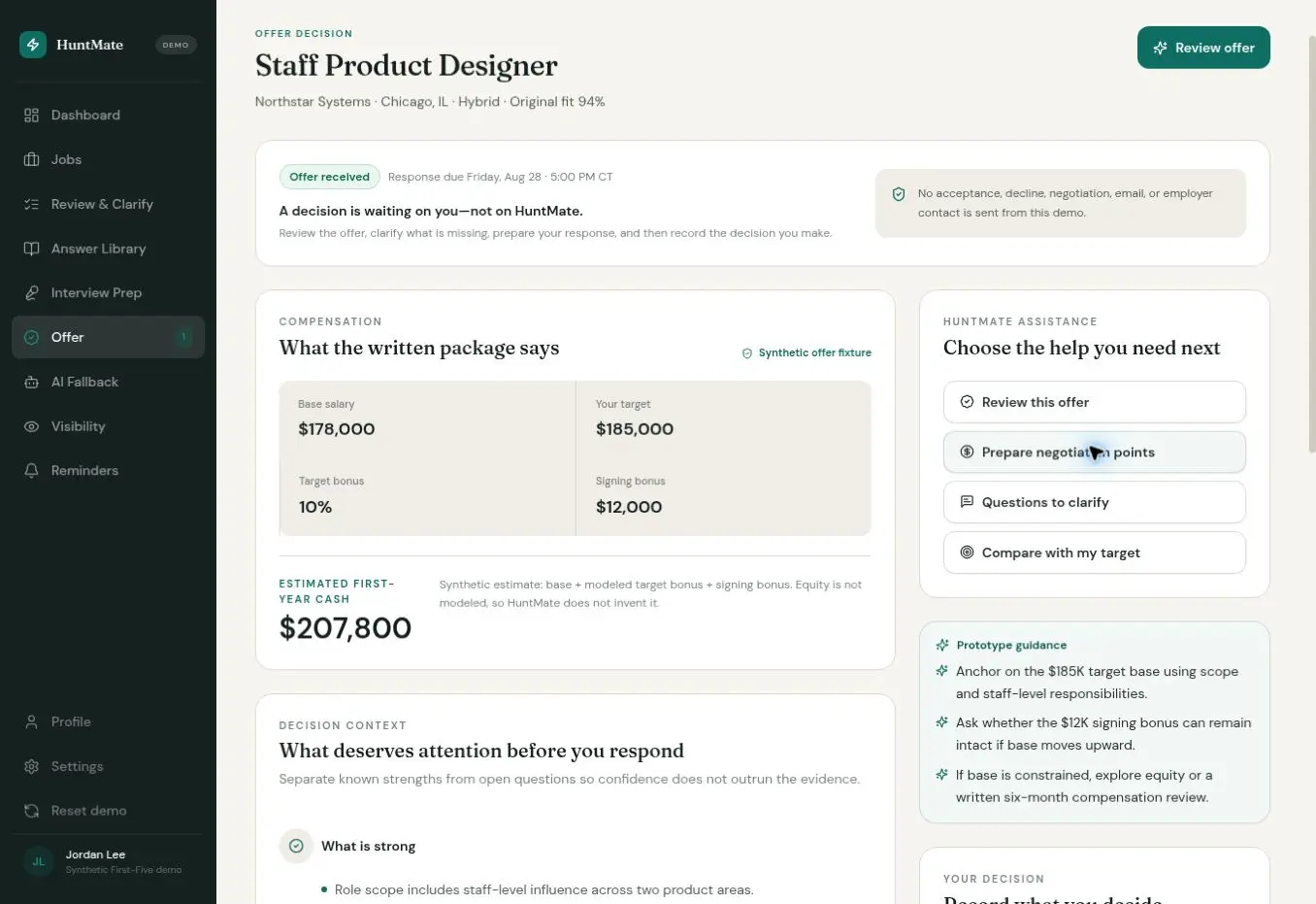
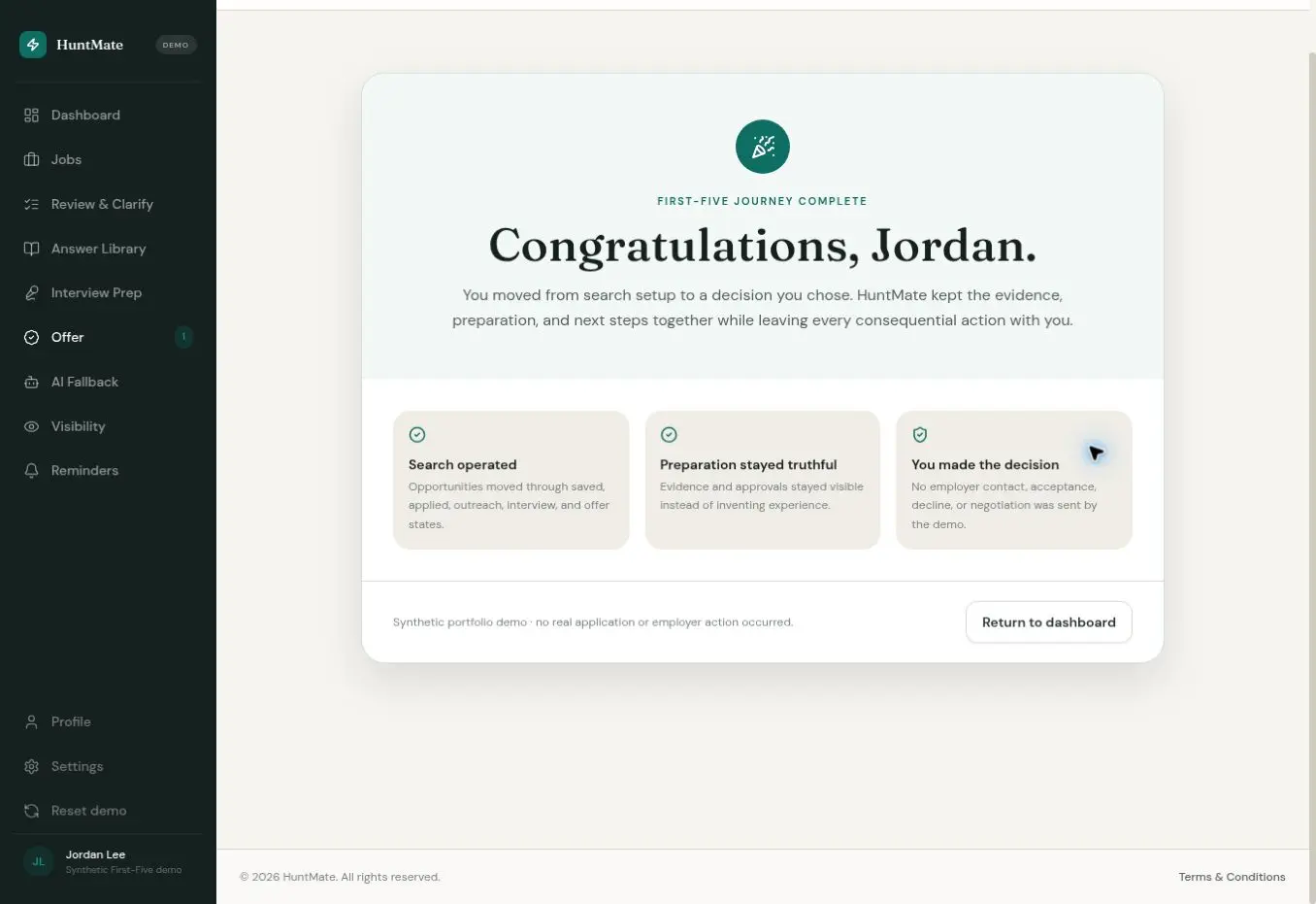
Help prepare the decision without making it.
Offer support separates known terms from open questions and prepares negotiation points. Hired closes the synthetic lifecycle after the person records a choice; it is not a measured hiring outcome.
04 / Investment brief
Before more investment, separate what is known, working, hypothesized, and missing.
The opportunity brief records the current framing, product evidence, assumptions, risks, and investment questions.
Read the opportunity brief05 / Stage-gate readiness
Each gate asks for specific evidence before moving on.
Problem Framed
Is the problem specific enough to investigate?
Root problem and affected workflow framed.
Opportunity Hypothesis
Could a connected workflow create meaningful value?
Category-level opportunity hypothesis; business value unproven.
Concept Defined
Is human + AI service coherent and bounded?
Journey, blueprint, control model, and risks defined.
Prototype Working evidence
Can the model work as a product?
Current First-Five demo with synthetic states.
Validation Next gate
Do people understand, trust, return to, and value it?
Controlled user evidence not collected.
Beta / invest Not yet earned
Has the opportunity earned broader investment?
Desirability and viability unresolved.
06 / Working product
Try the First-Five demo.
Start with simulated access, move through the connected opportunity workflow, and finish with offer decision support. The demo uses synthetic data and keeps consequential actions with the person.
Open live HuntMate demo ↗Synthetic data only. No application, email, employer contact, negotiation, acceptance, or decline is sent.
07 / What reality must answer next
What the next test needs to answer.
Current decision: Advance to controlled user validation.